





Introduction: Florence, frescoes and light
Florence is often called the cradle of the Renaissance — a place where art was rethought and where perspective, color and visual storytelling reached new heights. Among the city’s treasures, frescoes hold a special place: painted directly into wall and vault plaster, they represent a rare fusion of architecture, decoration and civic faith. Walking through Florence is sometimes like stepping into chapels where biblical and secular narratives are painted on walls, merging with stone, light and urban life to create sensory experiences that still move viewers today.
This guide offers an in-depth tour of Florence’s most famous frescoes, mixing art history, practical details (exact addresses, opening times and indicative prices) and local tips to help you make the most of each site. We’ll cover must-see works — cycles that changed the history of painting (Masaccio, Masolino, Filippino Lippi, Giorgio Vasari and others) — and give you keys to understand their importance, describe the feel of the places and suggest practical visiting tips (best times, tickets, behavior inside monuments and how to avoid the crowds).
Frescoes are not just mural paintings: they are devices for spatial storytelling. They direct your gaze toward an altar, follow the curve of a vault, and interact with stained glass and polished stone. In Florence these dialogues are sometimes political — commemorating a family’s glory or a commune’s power — sometimes devotional, sometimes didactic, and always rooted in demanding technique: preparing the arriccio, tracing the sinopia, choosing pigments, and working in giornate (day’s work segments). Understanding the technique helps you appreciate the artist’s gestures and the fragility of the heritage.
Each section of this article focuses on a specific set of frescoes or a place where fresco is queen. You’ll find immersive descriptions that let you imagine the experience before you go, practical information to plan your visit, and tips for photography, respecting the works and getting around (access, transport and recommended combined visits). The prices listed are indicative in euros and may change: always check official sites for current information.

The Brancacci Chapel (Basilica di Santa Maria del Carmine) — Masaccio, Masolino and Filippino Lippi
Full name: Cappella Brancacci, Basilica di Santa Maria del Carmine.
Address: Piazza del Carmine 14, 50124 Firenze, Italy.
Why it’s famous: The Brancacci Chapel cycle is considered a turning point in Renaissance painting. Executed in the early 15th century by Masaccio and Masolino (with later additions by Filippino Lippi), this cycle revolutionized the way the human figure, perspective and narrative were painted. While there’s no scene called « Paradise Hunt » here, panels like « The Temptation of Adam and Eve, » « The Expulsion from the Garden of Eden, » and episodes from the life of Saint Peter served as a handbook for generations of artists, including Michelangelo.
Immersive description: Stepping into the Brancacci Chapel — located in the right nave of the basilica — is like entering a painted storybook. Masaccio’s figures take on mass and volume; light seems to carve their muscles and drapery. Unlike the still-stylized figures of the late Middle Ages, here the psychology of characters emerges through gesture and facial expression. Masaccio introduced a sculptural simplification of forms and a clear perspective that makes the scenes extremely readable. Filippino Lippi completed parts after a 15th-century fire; his contributions show a move toward a more ornate style.

Opening times and access:
– Indicative hours: The Brancacci Chapel is generally open Tuesday through Sunday, with morning and afternoon slots; hours may vary with the season and religious services.
– Indicative price: Access to the Brancacci Chapel is sometimes included in a museum ticket for the Santa Maria del Carmine complex or sold separately — expect around €6 to €10 for the visit (2024–2025 indicative price).
– Booking: Access is limited to protect the frescoes. Book online or buy a ticket at the information point on site to guarantee entry.
Practical tips:
- Best time: Arrive early at opening to avoid tour groups. Late afternoon is often quieter off-season.
- How long: Allow 30 to 45 minutes to see the Brancacci Chapel carefully.
- Respect: The chapel is a place of worship; avoid flash photography and dress respectfully.
- Photography without flash is often permitted but monitored; check locally. Natural light inside the chapel is low: favor a fast lens or a high ISO if you’re shooting without flash.
- Combos: Pair the visit with the church and a stroll around the Santo Spirito neighborhood for a fuller Renaissance Florence experience.
The Dome of Santa Maria del Fiore — Vasari and Zuccari
Full name: Cupola di Santa Maria del Fiore (Frescoes of the Last Judgment), Cattedrale di Santa Maria del Fiore (the Duomo).
Address: Piazza del Duomo, 50122 Firenze FI, Italy.
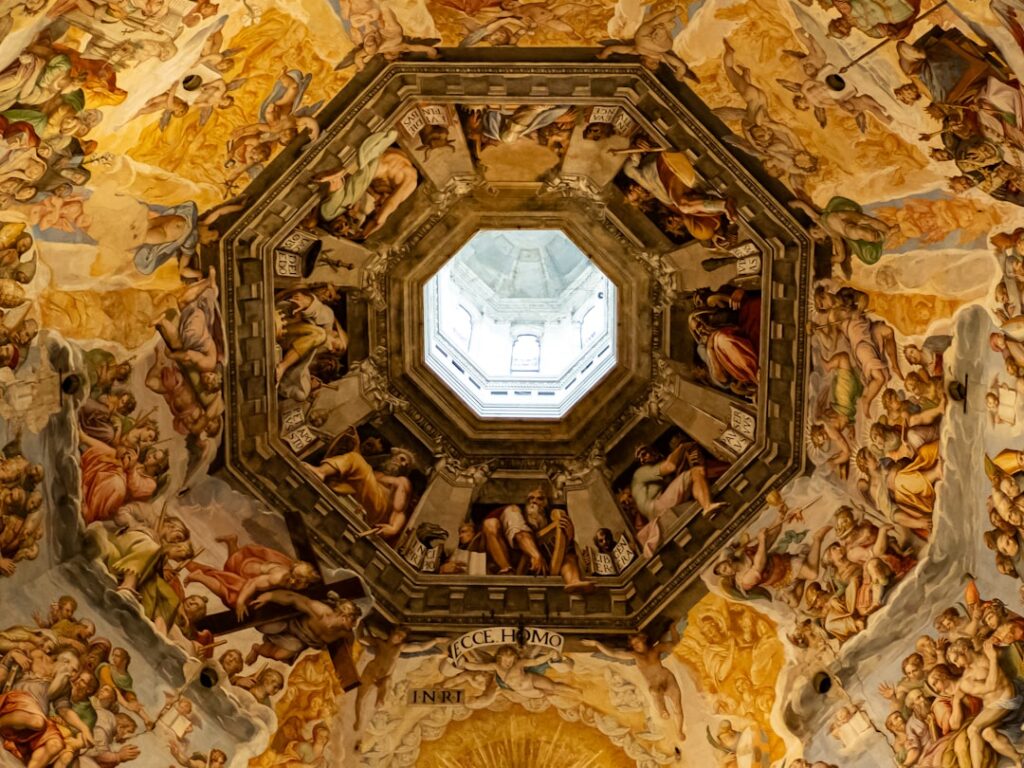
Why it’s famous: The monumental Last Judgment fresco covers the interior of the dome designed by Filippo Brunelleschi. Begun in the 16th century, the monumental decoration was painted mainly by Giorgio Vasari and completed by Federico Zuccari. Working on a dome required special techniques to make figures readable from the floor; the overall effect is both dramatic and enveloping.
Immersive description: Looking up beneath the Duomo’s dome, you’re wrapped in a visual storm: angels, the saved, the damned and apocalyptic scenes arranged in concentric registers. The scale and contrast between light filtering through the lantern and the interior shadows create a theatrical atmosphere. The artists designed the figures to be seen from the nave floor: proportions and perspective are adapted to that oblique view, producing an intensity almost cinematic in effect. Colors, though altered by time and restoration, still carry remarkable expressive power.
Hours and tickets:
– Cathedral hours: The cathedral is usually open daily, with variable opening hours (often 10:00–17:00 for interior visits, although masses can restrict access).
– Dome access: Climbing to the dome requires a ticket for the Duomo Complex (Biglietto Unico).
– Indicative price: The « Biglietto del Duomo » combined ticket (Cathedral, Dome, Baptistery, Museo dell’Opera del Duomo, Giotto’s Bell Tower) runs around €18 to €30 depending on options (2024–2025 indicative price).
– Booking: Ascent to the dome is limited by number and time slot. Book in advance (online) to avoid long queues.
Practical tips:
- The climb: The ascent involves many narrow stairs (about 463 steps); not recommended for people with reduced mobility or a fear of heights.
- Time needed: Allow 1 to 1.5 hours for the climb and visit if you want to take your time admiring the frescoes.
- Light: Good photos are hard to get because of interior light; favor a fast lens and no flash.
- Combo: Use the combined ticket to visit the Museo dell’Opera del Duomo to better understand the context of the frescoes and the building.
 Click here to book the ascent of Brunelleschi’s dome
Click here to book the ascent of Brunelleschi’s dome
The Tornabuoni Chapel and the frescoes of Domenico Ghirlandaio
Full name: Cappella Tornabuoni, Chiesa di Santa Maria Novella (or Tornabuoni Chapel depending on the exact location).
Reference address: Piazza Santa Maria Novella 1, 50123 Firenze FI, Italy (Basilica di Santa Maria Novella houses many Tornabuoni family works and Ghirlandaio cycles in Florence).
Why it’s famous: Domenico Ghirlandaio was one of the major Florentine masters of the late 15th century, renowned for his detailed narrative cycles, portraits of Florentine society and sense of realism. His work in the Tornabuoni Chapel (and other chapels commissioned by the Tornabuoni family) is an example of narrative fresco where the richness of costume details, urban landscapes and contemporary figures creates both a historical record and a work of art.
Immersive description: Ghirlandaio’s frescoes are like windows onto Renaissance Florence: you see not only religious episodes but familiar city architecture, exact costumes and portraits of patrons and court figures. The mastery of drawing, economical color use and the precision of faces make each panel clear and captivating. The artist excels in frieze composition; his scenes unfold in well-structured spaces where every figure seems to have a narrative role.

Hours and prices:
– Basilica di Santa Maria Novella hours: Open daily, typically from 9:00 to 17:00 or 19:00 depending on season; some areas may be closed during religious services.
– Indicative price: Entry to the basilica and museum around €10 to €15 (2024–2025 indicative price). Some chapels may require an extra fee or be accessible only via guided tour.
– Booking: Recommended for guided tours or groups.
Practical tips:
- Guided visit: A guided tour helps you spot historical details and the hidden portraits embedded in the compositions.
- Context: Combine the visit with Piazza Santa Maria Novella and the nearby train station; the neighborhood is a transport hub.
- Serenity: Seek out the chapel early morning or late afternoon for softer light and fewer touristic disturbances.
- Audio: Use an audio guide or an art-guide app to better understand Ghirlandaio’s complex scenes.
Click here to visit Santa Maria Novella with an audio guide
Click here to visit Santa Maria Novella with an audio guide

The Salone dei Cinquecento and the frescoes of Giorgio Vasari (Palazzo Vecchio)
Full name: Salone dei Cinquecento, Palazzo Vecchio.
Address: Piazza della Signoria, 50122 Firenze FI, Italy.
Why it’s famous: The Salone dei Cinquecento (Hall of the Five Hundred) is the grand ceremonial hall of Palazzo Vecchio. In the 16th century Giorgio Vasari was commissioned to decorate this vast room with frescoes and monumental ornamentation intended to celebrate the power of the Florentine Republic and later the Medici family. The frescoes and painted ceilings stage political and allegorical narratives rich with symbols and military or civic episodes.
Immersive description: Entering the Salone dei Cinquecento is like stepping into the heart of Florentine power. The frescoes, painted to cover immense surfaces, recount episodes of conquest, victory and civic virtues. Scenes are dynamic, often dramatized by figures in motion, horses mid-gallop and distant landscapes. Vasari’s decor, despite its monumental scale, is worked into the details: ornaments, cartouches and illusionistic architecture reinforce the space’s grandeur and political storytelling. The interplay between sculpture and painting gives the hall a theatrical dimension.
Hours and tickets:
– Hours: Palazzo Vecchio is usually open Monday to Sunday (variable hours, typically 9:00–19:00, sometimes closing at 17:00 off-season).
– Indicative price: Entry to Palazzo Vecchio around €12 to €16 (2024–2025 indicative price). Combined tickets or themed guided tours (access to private apartments, tower climbs) can cost more.
– Booking: Recommended to avoid queues; some areas are accessible only with a guided tour.
Practical tips:
- Acoustics: The hall is vast and echoes. To understand the imagery, read the panels or use an audio guide.
- Combined visit: Pair with Piazza della Signoria and the Loggia dei Lanzi for a full artistic stroll.
- Events: The palace occasionally hosts temporary exhibitions; check the calendar to enrich your visit.
Click here to visit Palazzo Vecchio with an audio guide
Click here to visit Palazzo Vecchio with an audio guide
Practical tips for seeing Florence’s frescoes
Florence is a very visited city; strategy is essential to get the most out of discovering its frescoes. Here are concrete, locally relevant recommendations.
Planning and tickets:
- Buy tickets online: Purchase skip-the-line tickets for the Duomo dome and heavily visited chapels (Brancacci Chapel, Ghirlandaio chapels, etc.).
- Combined passes: The Biglietto Unico del Duomo is often worth it if you plan to visit the cathedral, baptistery, museum and climb the dome.
- Check: The prices in this article are estimates (2024–2025). Always confirm current rates and opening hours on official websites before you go.
Gear and behavior:
- Photography: Flash is often forbidden. A camera capable of high ISO and image stabilization will deliver better results in low light.
- Respect: These places are often both museums and places of worship — keep noise down and dress appropriately.
- Shoes: Wear comfortable footwear: many visits include stone stairs and uneven floors.
- Time: Don’t rush the frescoes. Spend at least 20–30 minutes on a major cycle (Brancacci, Dome) and more if you want to read each scene closely.

Suggested one-day itinerary focused on frescoes
For enthusiasts, here’s a compact, well-paced one-day itinerary that maximizes encounters with Florence’s greatest fresco cycles without rushing.
Morning:
- Start at the Cattedrale di Santa Maria del Fiore (Piazza del Duomo) — buy the Biglietto Unico and climb early to the Dome to see the Last Judgment frescoes before the crowds arrive. (1 h 30)
- Descend and visit the Museo dell’Opera del Duomo to better understand the context. (1 h)
Midday:
- Lunch in the San Lorenzo area or along Via de’ Calzaiuoli — try a local panino or a pasta dish at a traditional osteria.
Afternoon:
- Walk to the Brancacci Chapel (Basilica di Santa Maria del Carmine, Piazza del Carmine 14) to contemplate Masaccio’s cycle. (45 min)
- Finish at the Palazzo Vecchio (Piazza della Signoria) to see the Salone dei Cinquecento. (1 h)
Evening:
- Stroll along the Arno and, if weather allows, enjoy the golden light on the city’s facades — a final look at a Florence that inspired so many artists.

Conclusion: Why Florence’s frescoes still matter
Florence’s frescoes are much more than religious illustrations: they are living documents of Europe’s artistic and social history. Each cycle tells a story — from technical experimentation (mass, perspective and light) to the political and devotional ambitions of patrons. Standing before a fresco in Florence can produce the same reaction that contemporaries felt: surprise at a new way to represent space, empathy for a character painted with unprecedented humanity, or admiration for a composition that orchestrates architecture, sculpture and painting.
Practically, visiting these works requires some organization: reservations, choosing time slots and attention to conservation rules. But the reward is immense: moments when paint, stone and light meet to tell timeless stories. Whether you’re an art-history aficionado, a photographer chasing powerful images, or a curious traveler, Florence offers frescoes that leave a lasting impression. Remember to check updated hours and prices before your visit, follow conservation guidelines and give each cycle the time it deserves. You’ll leave with not just images in your head but a deeper understanding of how art shaped — and continues to shape — the city.
Enjoy your journey through Florence’s frescoes — and take time to listen to what each wall has to tell you.