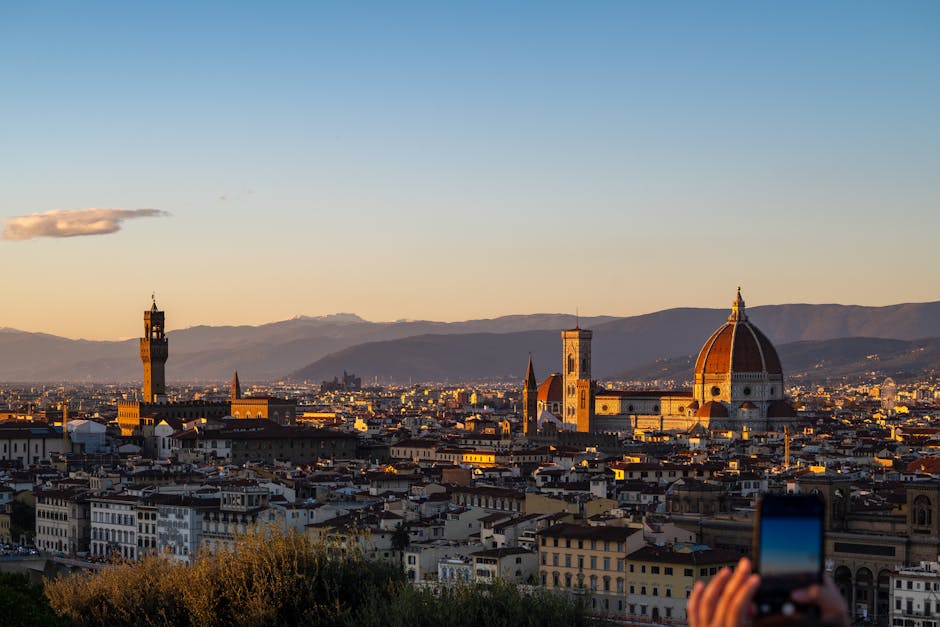






Introduction — Florence, a living laboratory of Tuscan architecture
Florence (Firenze) is the very essence of Tuscan architecture: a city where every street narrates the shift from the Middle Ages to the Renaissance, where stone, brick and marble converse with the warm evening light. For the architecture enthusiast, a single well-planned day can deliver a concentrated dose of visual thrills and historical insight: from Filippo Brunelleschi’s revolutionary dome to the ornate façades of the Palazzo Vecchio, passing through private courtyards, Renaissance gardens and medieval bridges. This guide lays out a complete, hour-by-hour route designed to maximize architectural discovery, pointing out the best viewpoints, hidden façades and interiors you shouldn’t miss.
On this typical day in Florence you’ll learn to read the city as an architectural book: how to spot the classical orders reinterpreted, identify the structural innovations that made the Duomo’s dome possible, understand the stylistic shift between Italian Gothic, Renaissance and Mannerism, and savor decorative details — friezes, capitals, stringcourses, fountains and tympana — that made Florence a training ground for architects and designers for centuries. The route alternates major monuments with more intimate stops (chapels, workshops, loggias) to vary scale: from massive volumes to carved details visible only to those who take the time to look.
This text also includes essential practical information: exact addresses, opening hours, prices in euros, booking tips and local hacks to avoid crowds and capture the best shots. The descriptions are immersive so you can picture each space before you arrive, and twenty small practical tips — shoes, sunglasses, coffee breaks, pedestrian shortcuts, public toilets, etc. — punctuate the itinerary. At the end, a conclusion sums up the experience and suggests ways to extend your architectural exploration in Florence and across Tuscany.
Note: opening times and prices vary with the season and occasional closures; always check official sites before your visit and, where possible, book skip-the-line tickets in advance (especially for the Duomo dome, the Uffizi Gallery and the Galleria dell’Accademia).

Morning: Piazza del Duomo — from the Gothic heart to Renaissance innovation (3–4 hours)
Start your day at the Cattedrale di Santa Maria del Fiore, better known as Florence’s Duomo, located at Piazza del Duomo, 50122 Firenze FI, Italy. The white, green and pink marble façade, completed in the 19th century, hides an interior of restrained grandeur that draws attention to the massive Last Judgment fresco beneath the dome. But for the architecture enthusiast the main attraction is Brunelleschi’s Cupola di Brunelleschi: a technical triumph from 1420–1436, the first large self-supporting dome since antiquity, which reshaped the design of sacred spaces by introducing novel structural solutions (a double shell, inner stairways and herringbone brickwork).
 Click here to book your ticket to climb Brunelleschi’s dome
Click here to book a ticket for the Duomo complex and Giotto’s bell tower
Click here to book your ticket to climb Brunelleschi’s dome
Click here to book a ticket for the Duomo complex and Giotto’s bell tower

Practical hours and prices:
- Cattedrale di Santa Maria del Fiore (Duomo) – Free entry to the cathedral itself (security checks may apply). Visits to the dome, baptistery, bell tower and the Museo dell’Opera del Duomo require a combined « Opera del Duomo » ticket: approximately €18 (prices vary). Booking recommended for the dome climb.
- Approximate opening times: Duomo (interior) 10:00–17:00 (seasonal); Cupola di Brunelleschi 8:15–19:00; Campanile di Giotto 8:15–19:00; Battistero di San Giovanni 8:15–10:15 then 11:15–19:30 (times subject to change). Check the Opera del Duomo site for exact hours on the day.
Visit tips: climb the dome early to avoid heat and queues; the ascent involves 463 narrow steps — bring sturdy shoes and be ready to catch your breath. The viewpoint from the dome’s drum lets you study the brick structure and supporting rings: note the alternating voussoirs and the internal scaffold strategy. After the dome, climb the Campanile di Giotto (Piazza del Duomo) for a panoramic reading of the city’s massing: rooflines, the dominance of the dome and the visual alignments that create Florence’s characteristic perspective.
Don’t miss the Battistero di San Giovanni (Piazza del Duomo) with its bronze doors (the famous Gates of Paradise — copies are on site, originals housed in the Museo dell’Opera del Duomo). The octagonal interior and the baptistery’s placement facing the cathedral explain the symbolic and ritual importance of this spot.
Mid-morning: Galleria dell’Accademia and the David — a lesson in proportion (1–1.5 hours)
After the Duomo, it’s an 8–12 minute walk to the Galleria dell’Accademia, located at Via Ricasoli, 58/60, 50122 Firenze FI, Italy. This gallery, famous for Michelangelo’s David, is a hands-on lesson in how sculpture and architecture talk to each other: the David, conceived as a monumental public piece, demonstrates a deep understanding of human scale, mass balance and ideal proportions that would later shape Renaissance architecture.
Click here to book a skip-the-line ticket for the Galleria dell’Accademia
Click here to book a skip-the-line ticket for the Galleria dell’Accademia

Practical hours and prices:
- Galleria dell’Accademia: around €12 (standard price), booking strongly recommended. Approximate opening hours: Tue–Sun 8:15–18:50, closed on Mondays. (Check before visiting.)
Architectural note: the building that houses the gallery retains conventual features modified in the 19th century; the rooms present a chronological layout that highlights the evolution of the human form and its architectural frames: niches, plinths, pilasters, cornices and treatments of light that emphasize the marbles. Take time to study Michelangelo’s workshop sketches and measurement marks — they reveal how the artist « constructed » the body in space, much like an architect constructs a building.
Practical tip: aim for a morning or late-afternoon visit to avoid crowds; if you’re an architect, bring a sketchbook for quick studies: the David room and the unfinished sculptures (the « Prigioni ») offer sectioned views and cut surfaces that reveal the constructive logic of marble.

Afternoon: Uffizi Gallery and Piazza della Signoria — sequences of civic and museum spaces (2–3 hours)
After lunch (some cafe suggestions further down), head to the Galleria degli Uffizi, at Piazzale degli Uffizi, 6, 50122 Firenze FI, Italy. The building itself, designed by Giorgio Vasari to house the Medici administrative offices (uffizi), is a fascinating example of courtyard-and-gallery architecture: a long enfilade opening to the Arno, with a loggia facing Piazza della Signoria, creating framed views and controlled perspectives — a key element of Renaissance urban planning.
Click here to book your Uffizi ticket with audio guide
Click here to get a skip-the-line ticket and audio guide for the Palazzo Vecchio
Practical hours and prices:
- Galleria degli Uffizi: standard ticket around €20 — often higher with online booking fees; usual hours Tue–Sun 8:15–18:30, closed on Mondays. Booking is mandatory in high season.
Architectural route: the interior is a succession of rooms that teach both pictorial history and the use of light, ceiling height and wall proportions to showcase artworks. Exit the gallery through the loggia facing Piazza della Signoria — a major civic space dominated by the Palazzo Vecchio (Piazza della Signoria, 50122 Firenze FI), Florence’s political heart since the 13th century. The Palazzo Vecchio, with its massive tower (Torre di Arnolfo), embodies the defensive and symbolic aims of civic architecture: thick walls, battlements, small windows and a vast entrance hall (Salone dei Cinquecento) decorated to affirm power and collective memory.
Visiting Palazzo Vecchio:
- Address: Piazza della Signoria, 50122 Firenze FI
- Opening hours: generally Tue–Sun 9:00–19:00 (hours vary)
- Price: around €12–15 depending on exhibitions and booking.
Observation tips: study the many decorative interventions (frescoes, stucco) that alter how the space is perceived; climb the tower if possible to appreciate the city silhouette and the relationship between civic power and urban landscape. Then stroll to the Ponte Vecchio to understand how commercial architecture integrates with the river setting: shops on the bridge, aligning façades and the history of artisan guilds.
Click here to book your Uffizi ticket with audio guide
Click here to get a skip-the-line ticket and audio guide for the Palazzo Vecchio

Late afternoon and evening: Pitti Palace, Boboli Gardens and Arno panoramas (2–3 hours)
Cross the Ponte Vecchio to reach the Palazzo Pitti and the Giardini di Boboli. The Palazzo Pitti sits at Piazza de’ Pitti, 1, 50125 Firenze FI, Italy. Once home to the Medici and later the Grand Dukes of Tuscany, the palace is a striking example of how a grand residential project was adapted to princely power, with internal courtyards, galleries and a series of heavy façades expressing both prestige and privacy.
Click here to book a ticket for Pitti Palace and the Boboli Gardens
Click here to book a ticket for Pitti Palace and Boboli Gardens

Hours and prices:
- Palazzo Pitti: around €10–16 for the museums inside the palace (varies with exhibitions).
- Giardini di Boboli: combined ticket often around €10–16 (reduced rates possible). Opening times vary with the season, typically 8:15–18:30 in high season, earlier closing in low season.
Visit and architectural reading: the Boboli Gardens are a wonderful laboratory where axes, viewpoints, artificial grottoes (Grotta del Buontalenti) and statuary engage in dialogue with the palace architecture. It’s the perfect place to analyze the staged landscape: terraces, monumental stairways, fountains and straight alleys that extend the palace’s visual axis into the Arno valley. The garden also reveals layers of intervention: medieval elements, Renaissance reworkings, Baroque additions and neoclassical touches.
Sunset tips: head up to Piazzale Michelangelo (Piazza Michelangelo) for an outstanding sunset panorama: the Duomo silhouette, the dome and the campanile stand out against the low light, offering a final lesson in scale relationships and urban composition. Piazzale Michelangelo is reachable on foot (about 20–30 minutes from Pitti) or by bus (lines 12/13 depending on route). It fills up at sunset — arrive 30 minutes early to pick your spot.
Culinary suggestions and architectural pauses
For lunch, favor a trattoria near the Duomo or the Uffizi:
- Antico Noè (example) — traditional Tuscan menus; check the current address locally.
- Osteria del Cinghiale Bianco — Tuscan specialties and generous portions.
These places sit within short walking distance of the monuments mentioned: enjoying a typical meal is also a way to observe the architecture of Florentine interiors — exposed beams, terracotta floors and small inner courtyards.

Local practical tips and photography tricks
- Bookings: for the Cupola, the Uffizi and the Accademia, book online at least 48 hours ahead in high season. Skip-the-line tickets can save you hours.
- Shoes: comfortable, grippy footwear. Florence is best explored on foot; cobbles and steps are everywhere.
- Golden hours: sunrise and sunset deliver the best light on the Duomo’s marble façades and along the Arno. Time your movements to catch these moments.
- Gear: a small compact tripod for interiors (observe museum rules), a wide-angle for internal volumes and a telephoto for sculptural details.
- Transport: the historic center is very walkable; taxis and buses exist, but the core area is largely pedestrian. Carry coins for public toilets and modest tips (5–10%).
- Safety: pickpockets operate, especially around tourist sites. Keep valuables close and use zippered pockets.
Conclusion — One day as the beginning of an architectural education
A day devoted to Tuscan architecture in Florence doesn’t claim to cover everything, but it can lay solid groundwork for understanding why this city shaped Europe for centuries. Starting from the Duomo and Brunelleschi’s structural revolution, through Michelangelo’s sculptural finesse at the Accademia, the civic authority of the Palazzo Vecchio and the urban elegance of the Uffizi, you’ll traverse different registers: religious, civic, residential and landscape architecture. Each of these responds differently to the same questions: how do you design space to express devotion, power, prestige or everyday life?
Architecturally, Florence teaches the importance of scale, proportion and materials; it also shows, through urban alignments and controlled perspectives, that architecture is a public art: it shapes collective narratives and creates places that condense memory and identity. A well-planned day lets you experience these ideas physically — by climbing, looking, occupying piazzas and loggias — rather than just reading about them in a guidebook.
If you have extra time, extend your exploration: visit the Basilica di Santa Croce (Piazza di Santa Croce, 16, 50122 Firenze FI) for its chapels and tombs of famous Florentines (hours and prices vary, entry around €8–10), or push on to Fiesole for hilltop views and Roman remains. If you’re an architect or student, schedule a themed visit (stonecutting workshop, guided tour focused on construction systems, façade reading) to dive deeper into technique.
Florence remains a perpetual school: return at different times of year to see how light and vegetation transform the same stones. Above all, take time to sit on a piazza bench, take notes, sketch a cornice or simply watch how locals use these spaces — often the best way to learn how architecture truly functions.
