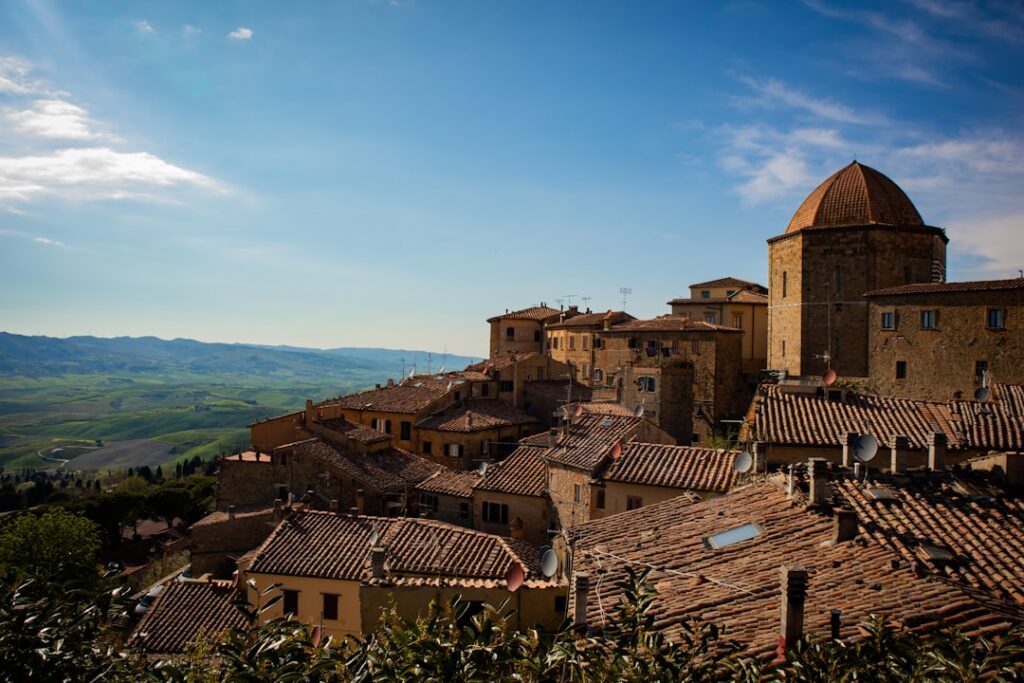






Introduction: Volterra — an Etruscan town you can explore in a day from Florence
Volterra reads like an open history book: cobbled lanes, massive walls, and a tangible Etruscan legacy peeking around every corner. Located about 80 km southwest of Florence, it’s perfect for a day trip if you want archaeology, sweeping Tuscan views and local craftsmanship without spending all day on transfers. Whether you arrive by car, on a guided tour, or by train + bus, the old town concentrates the main sights in a compact area, so you can enjoy a rich experience without rushing.
For lovers of antiquity, Volterra’s main draw is its Etruscan heritage: tombs, funerary objects and stone urns tell the story of a civilization that predated Rome and still holds mysteries. But Volterra isn’t just archaeology: there’s a Romanesque cathedral, an imposing medieval town hall, small squares where you can savor simple generous Tuscan cooking, and alabaster workshops where craftsmen keep centuries-old techniques alive.
This article is laid out as an optimized one-day itinerary from Florence: suggested timings, exact addresses, practical prices (in euros), immersive descriptions of must-see monuments and local tips to get the most out of your day. I’ll walk you step by step so you see the highlights without running, with time-saving pointers (combo tickets, busy hours, where to eat, which alabaster shop to favor, etc.). If you’re specifically into Etruscan history, there are extra addresses to dive deeper; if photography is your focus, I flag the best viewpoints and the times of day for ideal light.
Before you go, remember Volterra sits on a hill: expect ups and downs, so wear comfortable shoes. The lanes are narrow and medieval, with sometimes uneven cobbles. There are very few large free parking areas in the center; in high season, arrive early. The local town administration prioritizes conservation and access—check opening hours for your date (museums can change schedules off-season). Now, let’s open the doors of the Etruscan town together.
 Click here to book your skip-the-line Accademia Gallery ticket

Guarnacci Etruscan Museum and Etruscan memory (in-depth visit)
The Museo Etrusco Guarnacci is the must-see reference for understanding Volterra and the regional Etruscan civilization. Exact address: Piazza Guido da Volterra, 1, 56048 Volterra PI, Italy. The museum houses one of Italy’s oldest public collections and features an outstanding array of stone funerary urns (anthropoid tombs) and large sarcophagi dating from the 6th–4th centuries BCE. The central hall displays finely carved motifs, votive figurines and everyday objects that give an intimate view of Etruscan society.
Opening hours (indicative—verify before you travel): Tuesday to Sunday: 09:00 – 19:00, closed on Monday. Admission: €10.00 for an adult ticket (reduced €6.00 for students/young people; possible free entry for very young children depending on local policy). The museum sometimes sells a combined ticket with other municipal sites—ask at the desk to save time and money if you plan to visit the Palazzo dei Priori or the Teatro Romano.
The visit is immersive: start on the ground floor to see the large anthropoid urns, then climb to follow the chronological story of the finds. Labels are usually in Italian and English; if you’re passionate, take an audio guide (often available) or book a guided tour in English/Italian to get details on burial rituals, the symbolism of decorations and carving techniques. The museum also has themed displays comparing Etruscan art with Greek and Roman objects found in the area, which provides valuable context.
- Practical tip: arrive at opening time to avoid groups and to get soft light for photographing the rooms.
- Ticket tip: ask for the day’s “biglietto combinato” at the desk—it may include the Teatro Romano.
- Accessibility: some rooms are upstairs and there are stairs—plan for limited mobility if needed.

Piazza dei Priori, Palazzo dei Priori and medieval civic life
Volterra’s civic heart is the Piazza dei Priori, easy to spot when you enter the old town. Address: Piazza dei Priori, 56048 Volterra PI, Italy. Dominating the square is the Palazzo dei Priori, the oldest still-functioning town hall in Tuscany, built from the 13th century onward. Its crenellated façade, tower and coats of arms tell municipal stories and medieval rivalries: the palace is a splendid example of civic architecture, perfect for appreciating the symbolic power of Italian communes.
Opening hours for the Palazzo dei Priori: often open to the public in the morning from 10:00 to 13:00 and in the afternoon from 15:00 to 18:00 (hours vary by season and events). Indicative price to access exhibit rooms: €4.00 (reduced €2.00). Also check whether the Loggia dei Priori and the historic rooms—frequently used for temporary exhibitions—are open.
The square itself is perfect for a coffee break: several cafés and small trattorie line the piazza. Sit on a terrace and watch Volterran life unfold—local officials, craftsmen, tourists photographing the fountain and columns—the scene feels authentically Tuscan, less staged than Florence. A few steps away, explore the adjacent lanes to find alabaster workshops and small antique shops.
- Photo tip: the best light on the Palazzo dei Priori façade is in the morning, when the sun illuminates the square without harsh shadows.
- Where to get coffee: “Caffè dei Priori” (a generic name for one of the cafés on the square) — an espresso costs around €1.20–€1.50.
- Local purchase: ask the piazza shops if there are free alabaster demonstrations—many artisans are happy to show their craft.
The Roman Theatre, Porta all’Arco and archaeological remains in town
Two major traces of antiquity lie close to each other: the Teatro Romano di Volterra and the Porta all’Arco. The Teatro Romano is a dive into the Roman era that followed Etruscan dominance. Address for the Teatro Romano: Area Archeologica Teatro Romano, Via del Teatro Romano, 56048 Volterra PI, Italy. The partially excavated remains include the cavea (seating) and the stage area; the view from the site opens onto the valley, amplifying the feeling of antiquity suspended in time.
Hours: generally 09:00 – 17:00 outside high season; in summer opening sometimes extends to 19:00. Price: single ticket €6.00 for the archaeological site (reduced €3.00). Entry is often combinable with the Museo Etrusco Guarnacci—check at the museum.
A few minutes’ walk from the theatre, the Porta all’Arco is an Etruscan gate remarkably well preserved at its base, later integrated into Roman and medieval walls. Approximate address: Via Porta all’Arco, 56048 Volterra PI, Italy. This relic is ideal for gauging wall thickness, construction techniques and features of ancient urban defense. The gate is photogenic in the early morning or late afternoon when the low sun brings out the stone’s textures.
- Practical tip: pair an early-morning visit to the Teatro Romano with a stroll to the Porta all’Arco to avoid afternoon crowds.
- Accessibility: the theatre site has gravel paths and steps; wear comfortable shoes.
- More info: small explanatory plaques on site provide details in Italian and English; for deeper context, refer to the Guarnacci museum.
Alabaster craft, shops and lunch: a sensory experience
Volterra is famous for its alabaster craft—a soft stone worked since the Renaissance into objects, vases and sculptures. For an authentic immersion, head to the Officina dell’Alabastro and the workshops along Via Porta all’Arco / Via San Felice (the main streets are full of shops). Examples of known workshop addresses: Officina dell’Alabastro, Via del Teatro Romano, Volterra (approximate: several workshops run along the pedestrian area around the Teatro Romano and Piazza dei Priori). You’ll see carving demonstrations and can buy souvenirs directly from the artisan.
Price guide: small souvenirs (shells, coasters) from €10.00, medium decorative pieces €50.00–€150.00, larger sculptures by quote. Workshops often accept cards and cash; for heavy or fragile items, ask for reinforced packaging for transport.
For lunch, choose a traditional trattoria: order a local dish like pappa al pomodoro, mushroom pasta or a Tuscan charcuterie plate with a glass of Chianti. Recommended restaurants cluster around Piazza dei Priori or Via Roma (names vary by season). Lunch budget: full meal between €15.00 and €30.00 per person depending on wine choices.
- Smart buy: politely negotiate for multiple items or ask for a discount if paying in cash.
- Packing and shipping: request a certificate of origin if you’re taking the piece on an international flight (customs formalities may apply depending on value).
- Taste tip: try the local schiacciata (flatbread) with olive oil and rosemary, often served as an antipasto.

Practical tips for a successful day trip from Florence
Practical route from Florence: leave early (around 08:00) to reach Volterra in 1h20–1h45 by car depending on traffic; by public transport, take a train to Pontedera or Empoli then regional buses (companies Tiemme/BusItalia), allow 2h30–3h. Main bus station: Autostazione Volterra at the entrance to the old town (general address: Piazza Martiri della Libertà, 56048 Volterra PI). If you use a tourist bus or organized excursion, check how much free time is left on site (minimum 4–5 hours for a solid overview).
Parking: main car parks near the old town entrances are Parcheggio Parterre (address: Via Matteotti / Via Roma) and Parcheggio Porta a Selci: spaces are often paid (around €1.50–€2.00 / h). Take a ticket and check the indicated tariff zone. Avoid driving inside the historic center: limited traffic zones (ZTL) are strictly enforced; obey signs to avoid fines.
Hours and season: summer (June–September) is busiest, but morning and evening light is ideal for photos. Off-season (November–February), some museums reduce hours—check the day before. If it rains, museums and alabaster workshops make great indoor alternatives.
- Wear comfortable shoes: cobbles, steps and slopes are everywhere.
- Cash: although cards are accepted, bring some cash for small purchases and cafés.
- Recommended time on site: minimum 5–6 hours to see the main sights without rushing; ideally 8 hours to add a museum visit and an alabaster workshop.
- Photography: respect “no flash” signs and private areas in artisan shops.
Click here to book your ticket for the Accademia Gallery
Click here to book your ticket to climb Brunelleschi’s Dome

Conclusion: one day, one identity — Volterra as a living gateway to the Etruscans
A day in Volterra from Florence may feel short, but if planned well it lets you penetrate Etruscan history, sense the medieval austerity of the center, and bring home tangible souvenirs—alabaster pieces, photos of lanes and a notebook full of observations. The Museo Etrusco Guarnacci unlocks the rituals and material culture of the Etruscans; the Piazza dei Priori and Palazzo dei Priori tell the story of a medieval commune; the Teatro Romano and Porta all’Arco show layers of ancient occupation.
To get the most from your excursion, schedule visits around museum and parking hours, book guided tours if needed (especially in high season) and favor early time slots to avoid tourist flows. Bring a refillable water bottle, suitable shoes and a small notebook to note artisans’ names and objects that move you—alabaster shops are often family-run and can tell multi-generation stories.
Volterra is not just an archaeological destination: it’s a sensory, human experience. Between stone that still bears Etruscan forms, golden light on the walls and the flavor of a Tuscan meal, the town lends itself to a short but meaningful immersion. Even with only one day, you’ll leave Volterra with a deeper understanding of ancient Italy and everyday Tuscany—fuel for more historical day trips in the region.
One last tip: leave time to wander aimlessly — a random lane, a discreet palazzo or an unexpectedly opened alabaster workshop can produce moments as precious as an official guided tour. Safe travels, and enjoy discovering Volterra, the Etruscan town that’s easy to reach from Florence.