





Introduction
Florence, the heart of Tuscany, is a city where light tells centuries-old stories. Bisected by the Arno, it offers one-of-a-kind urban scenes at sunset: Renaissance façades turn golden, rooftops become silhouettes, and every bridge frames a perfect photograph. This photo route focuses on the stretch along the Arno, with stops chosen to capture the best light, the most striking reflections, and the architectural details that make Florence so photogenic. Whether you’re an amateur shooting from a smartphone or a seasoned photographer with a tripod and filters, you’ll find practical tips here on composition, camera settings, and timing.
The route starts in the historic center and finishes up on the hills, passing iconic viewpoints and quieter corners. You’ll learn where to set up your tripod, which lenses to favor (wide-angle for sweeping Arno panoramas, telephoto to isolate a window or statue), how to handle white balance at sunset, and what settings work best to capture façade reflections in the water. We’ll also include practical info: full addresses, admission prices when relevant, opening hours, transport suggestions, and safety tips for your gear. The goal is to provide not just a visual walk but a realistic late-afternoon-to-night itinerary.
This guide is designed to be done on foot, with taxi or bus alternatives if you’re short on time or carrying heavy equipment. Stops are arranged to maximize variety: wide shots from the Arno’s banks, tight frames on Ponte Vecchio’s shops, dramatic backlighting from Lungarno degli Acciaiuoli, and panoramic vistas from Piazzale Michelangelo. For each stop we offer variations depending on the weather: clear skies, dramatic clouds, or a light mist over the river. Don’t forget to take breaks for a local treat — a gelato or a schiacciata — and to enjoy terraces that double as great photo spots. Charge your memory cards and batteries, and follow this route designed to turn a simple sunset into a series of memorable images.
Starting point: Ponte Vecchio and nearby riverbanks
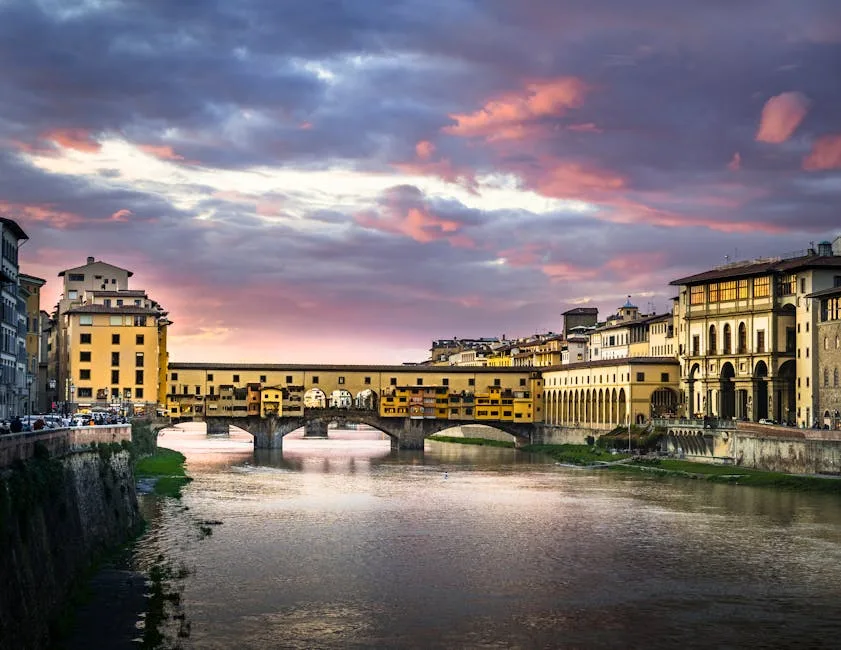
Begin your route at the heart of Florentine iconography: the Ponte Vecchio. Address: Ponte Vecchio, 50125 Firenze FI, Italy. This medieval bridge — literally the « old bridge » — is lined with jewelry shops and workshops that reflect in the Arno. Access is free, and it’s most spectacular in the late afternoon when golden light bathes the ochre and yellow façades. Shop hours vary, typically opening between 10:00 and 20:00 depending on the season; the bridge itself is accessible 24/7.
For the classic shot, position yourself on the north bank (Lungarno degli Acciaiuoli) facing the park on the south bank, level with Via Por Santa Maria. Use a wide-angle if you want to include the full bridge reflection and the street perspective leading to it. If you prefer a more intimate frame, step onto the bridge and isolate a single shopfront or an arched passage. The ideal moment is about 30 to 40 minutes before sunset to capture the bridge in silhouette and then the warm tones on the stone.
Practical tip: the bridge gets very crowded. If you want a crowd-free shot, arrive early (just before the golden hour) or wait until after dark when tour groups disperse. Watch out for pickpockets in this very touristy area; keep your bag closed and the camera on a crossbody strap. For a different angle, cross the bridge and climb a few steps on Via Guicciardini for a slightly elevated perspective.
Lungarno degli Acciaiuoli and façade backlighting
After Ponte Vecchio, follow the north bank west along Lungarno degli Acciaiuoli (typical nearby address: Lungarno degli Acciaiuoli, 50123 Firenze FI). This riverside walk offers continuous perspectives of the water and aligned houses. Colorful façades and low balconies create repeating patterns ideal for a series of shots. Reflections on the water become moving paintings, especially when the wind is calm.
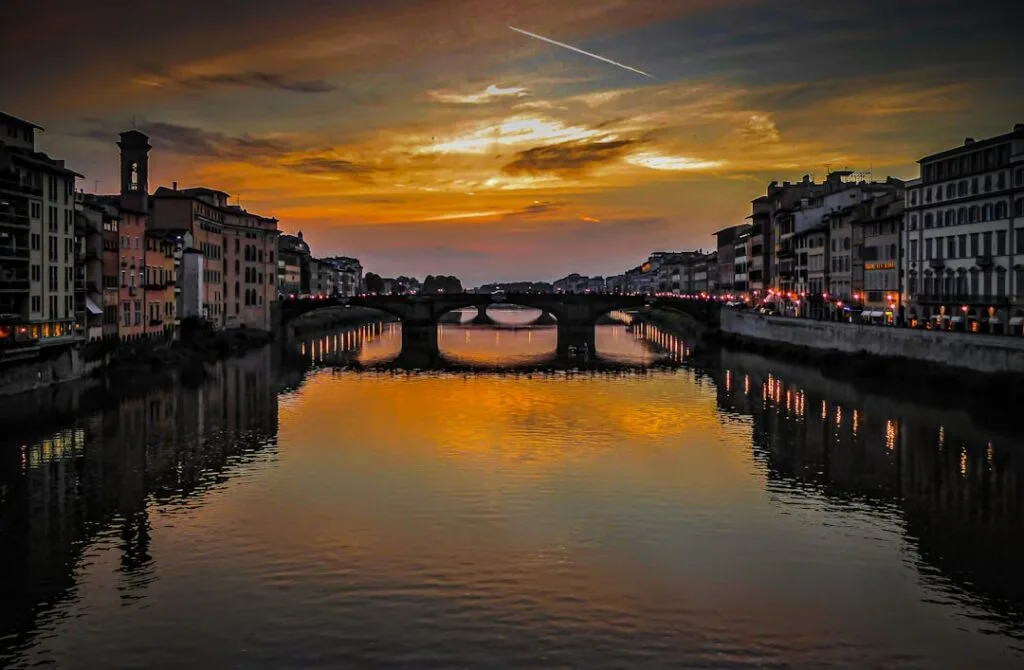
Halfway along you’ll find Ponte alla Carraia and, a short distance away, Ponte Santa Trinita. Ponte Santa Trinita, located at Piazza Santa Trinita, 50123 Firenze FI, is notable for its elegant curve and statues on the piers. Crossing this bridge gives you a beautiful backlit view of the façade of Palazzo Spini Feroni, home to the Museo Salvatore Ferragamo (Piazza Santa Trinita, 5/R, 50123 Firenze; admission varies by exhibition, generally around €9–12, hours 10:00–18:00). The contrast between sky and the Lungarno arcades is a great playground for exposing creatively.
Recommended technique: use bracketing (multiple exposures) if your camera offers it. Shoot 3–5 frames at different exposures to build an HDR if needed — handy to preserve shadow detail in façades while keeping the sky’s highlights. On a smartphone, split the frame into zones and tap the screen to adjust local exposure. Museum hours along the Lungarno can vary; check official sites before planning a visit.
Piazza della Signoria and Palazzo Vecchio: architectural details
Heading toward Piazza della Signoria takes you briefly away from the water but into grand architectural theater. Address: Piazza della Signoria, 50122 Firenze FI. At the center stands the Loggia dei Lanzi and a replica of Michelangelo’s David (the original is at the Museo dell’Accademia). Nearby, Palazzo Vecchio (Piazza della Signoria, 50122 Firenze; museum admission around €12 for the standard route; hours 9:00–19:00, closed on some holidays) offers towers and vantage points with views over the Arno.
Sunset light transforms the piazza’s marbles and bronzes. Photograph statues in silhouette against warm skies, or isolate a sculpture with shallow depth of field. Climbing the Palazzo Vecchio tower (when open) gives an excellent viewpoint to frame the Arno in the background, including Ponte Vecchio and the continuity of rooftops. The contrast between medieval stone and soft evening light is a Florentine classic.
Practical tip: buy tickets online for Palazzo Vecchio and the Uffizi Gallery (Galleria degli Uffizi, Piazzale degli Uffizi, 6, 50122 Firenze; standard ticket around €20 + reservation; usual hours 8:15–18:30, closed Monday) if you want to visit the interiors before sunset. Lines can be long in high season. If you prefer shooting outside, Piazza della Signoria is always accessible. For a unique frame, wander the alleys leading back toward the Arno — sometimes a simple doorway or a window framed by greenery makes a surprising composition.
Piazzale Michelangelo: the panoramic lookout
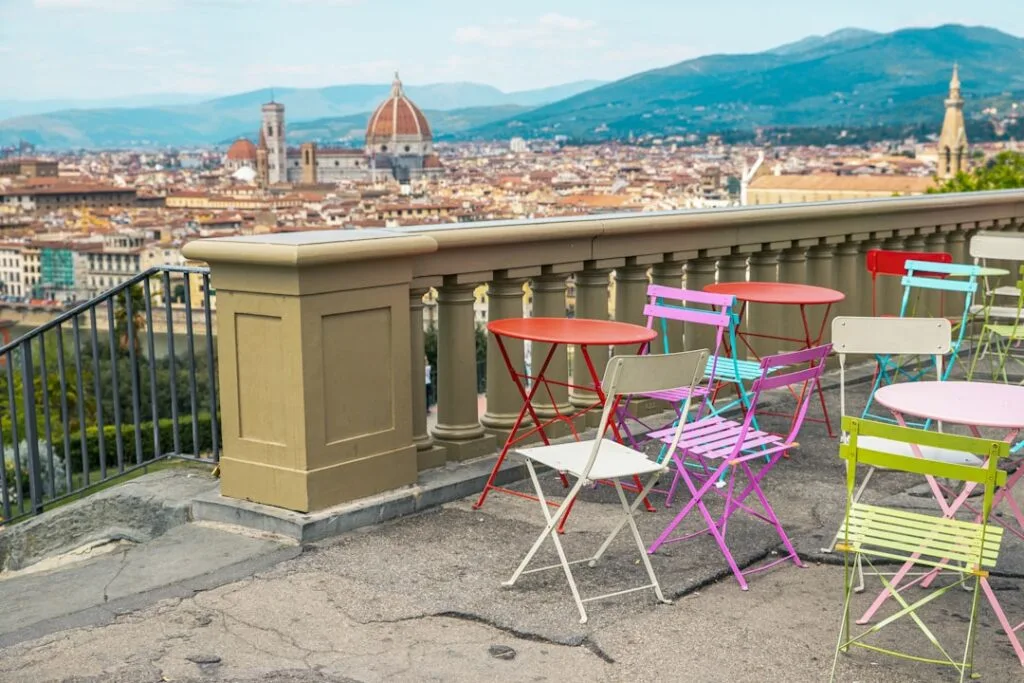
Finish your route at Piazzale Michelangelo for a complete panorama of Florence and the Arno. Address: Piazzale Michelangelo, 50125 Firenze FI. This viewpoint is reachable on foot (about 20–30 minutes from the center, via stairs and paths) or by bus/taxi (bus no. 12, stop « Piazzale Michelangelo » from Santa Maria Novella station). The piazzale is open all day and access is free.
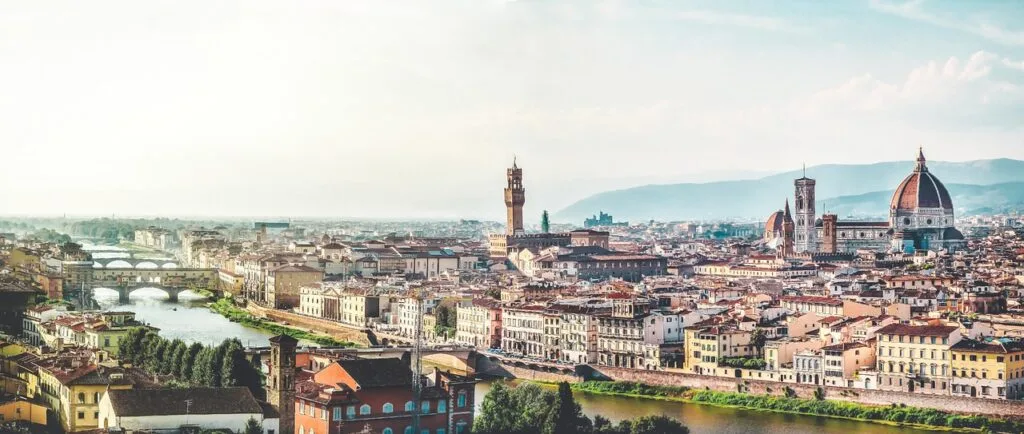
From the terrace, the view includes the whole city: the Duomo di Firenze (Cattedrale di Santa Maria del Fiore, Piazza del Duomo, 50122 Firenze; full monument ticket about €18 valid 72 hours, hours vary by element), Giotto’s Campanile, the silhouette of Ponte Vecchio, and the silver ribbon of the Arno cutting through the town. Sunset from here is spectacular because you can compose with foreground elements (bronze statues, trees, benches) against the urban backdrop. For photos, use a mid-range to tele photo lens to compress layers of roofs and hills.
Technique and practical advice: arrive about 45 minutes before sunset to stake out your spot. A tripod helps for long exposures after dark to capture monument lighting. Watch for wind: the terrace can be exposed and affect stability. For night photography, set a moderate ISO (400–800 depending on your gear) and experiment with shutter speeds between 1 and 6 seconds to get soft water reflections. Bring a small headlamp to descend safely if you leave after dark.
Technical and logistical tips for a successful shoot
A city photo route requires technical and logistical preparation. Here are concrete tips to optimize your Arno session.
Recommended gear: a camera with manual controls, a wide-angle lens (16–35 mm) for panoramas, a mid/tele lens (70–200 mm) for details and sculptures, a compact tripod, graduated ND filters to balance sky and river, and a remote or self-timer to avoid shake. If you’re using a smartphone, consider a teleadapter and an app that lets you control ISO and shutter speed. Bring at least two batteries and extra memory cards.
Suggested settings: for sunsets, start around f/8–f/11 for sharpness, keep ISO low (100–200) and expose for the highlights if you want silhouettes, or use bracketing to recover as much detail as possible. For water reflections, underexpose by 1/3 to 1 stop to preserve saturated colors. After the sun dips, increase exposure time to capture city lights and get a mirror-like Arno.
Logistics: plan your route around sunset times (check seasonally), avoid peak tourist hours (10:00–16:00), and schedule breaks for water and food. Many Lungarno cafés serve aperitivi — a great chance to recharge and shoot close-up details (try crostini Toscani and a glass of Chianti). Respect local rules: some museums and buildings prohibit tripods without permission. If it rains, bring waterproof covers and protective bags for your lenses.
Conclusion
Sunset on the Arno is both a visual and sensory experience: shifting light reveals layers of history and beauty that make Florence endlessly rewarding for photographers. By following this route — from Ponte Vecchio along the Lungarno, through Piazza della Signoria and up to Piazzale Michelangelo — you’ll capture a wide palette of perspectives: tranquil reflections, architectural details, backlit silhouettes, and blazing panoramas.
Key takeaways: arrive early to set up your gear, adapt settings to the sky-and-river dynamics, and use different heights and distances to vary compositions. Also consider practicalities: museum hours and prices if you want to combine visits with photography, transport options (walking, bus no. 12, taxis), and equipment safety tips. The useful addresses mentioned in this article — Ponte Vecchio (Ponte Vecchio, 50125 Firenze FI), Galleria degli Uffizi (Piazzale degli Uffizi, 6, 50122 Firenze), Palazzo Vecchio (Piazza della Signoria, 50122 Firenze), Piazzale Michelangelo (50125 Firenze FI), and the Duomo di Firenze (Piazza del Duomo, 50122 Firenze) — will help you plan your route precisely.
Finally, remember that travel photography is as much about patience as technique. Give yourself time to observe, wait for the light to arrive, and explore unexpected angles. Sometimes the most powerful image isn’t the full monument but the reflection in a window, a hand on a balustrade, or a boat gliding slowly across the Arno. Safe travels and great shots — may your images capture the softness and grandeur of a Florentine sunset on the Arno.