


Introduction: Giardino Bardini, a Florentine gem where art meets nature
The Giardino Bardini, perched on the south bank of the Arno in Florence, plays both the role of a spectacular viewpoint and an open-air museum. Located close to must-see landmarks like the Ponte Vecchio and the Chiesa di Santa Maria del Fiore, it offers a stroll where landscape history mixes with sculpture, baroque touches and late Renaissance design. The garden is part of the Fondazione Parchi Monumentali Bardini e Peyron and perfectly complements nearby cultural sites such as the Giardino di Boboli and the Museo Bardini.
Contenu de l'article
For visitors, Bardini is a sequence of visual scenes: the famous monumental French-style staircase, terraces planted with roses and citrus, intimate groves and—for our focus—scattered sculptures that punctuate the walk. These works are not isolated objects; they converse with the topography, the panoramic views over the city and the layout of the paths. Whether you love art, photography, or simply seek a peaceful spot away from the tourist crush, tracking down Bardini’s sculptures reveals a quieter, more secret side of Florence.
This article lays out a thematic route: the « Top 7 Sculptures to Spot in Giardino Bardini. » For each piece or sculptural group we give: the name (when known), precise location in the garden, an immersive description, tips on the best time and angle to view or photograph it, plus essential practical info for your visit (address, opening hours, indicative prices). Note: hours and prices can change with the season or temporary exhibitions; we provide typical information and recommend checking online before you go.
 Click here to book your ticket for the Pitti Palace and Boboli Gardens

Before we dive into the seven sculptures, here are the essentials to plan your visit: address: Giardino Bardini, Costa San Giorgio 2, 50125 Firenze FI, Italy. Indicative opening hours: April–September roughly 08:15–19:30; October–March roughly 08:15–16:30 (holiday closures may vary). Indicative prices: single adult ticket ≈ €10, reduced ≈ €7, combined Boboli + Bardini ticket ≈ €12–15. These figures are only for guidance: check the official Comune di Firenze or Fondazione sites to confirm. Now, follow me to discover the sculptures that make Bardini a little open-air museum.
1) The grand staircase and the allegorical statues on the Terrace (Escalinata monumentale)
The main access to Giardino Bardini is often via the spectacular Escalinata monumentale, a broad French-style ramp lined with statues and ornamental vases. This architectural and sculptural composition, visible from Costa San Giorgio, structures the climb and offers successive vantage points over Florence. The sculptures along the staircase are mainly allegorical figures and busts that reflect the neoclassical and baroque tastes adopted during 19th–20th century refurbishments.
As you walk up the stairs, take time to study the poses of the statues: some freeze moments of contemplation, others lean on attributes (cornucopias, shells, instruments). The contrast between the pale marble and the warm ochre stone of the ramp, especially in low morning or evening light, makes for very photogenic scenes. The staircase itself is a kind of stage-set: it frames the town in the distance and guides the eye toward the upper Belvedere.

Practical tips: to avoid crowds and get the best light, visit the staircase early in the morning (or just before sunset). If you’re a photographer with a long lens, isolate the busts and play with the staircase perspectives. Wear comfortable shoes: the stairs are long and often irregular. It’s easy to reach from the nearest bus stop or on foot from the Ponte Vecchio (about 10–15 minutes).
2) River gods and fountains: the sculpted presence of water
On some terraces you’ll find fountains where sculpture meets water. Standout pieces include sculptural groups of river gods and marine creatures—traditional motifs in Italian garden design symbolizing fertility and the relationship to water. These works, often made of stone or patinated stucco, contribute to the cool, refreshing feel of these green niches.
Watching the play of water and the effects of patina is especially rewarding after a light rain, when the stones’ colors deepen and the sculpture’s reflection merges with surrounding foliage. For art-history lovers, these groups echo antique motifs revived by Renaissance and late baroque artists: tritons, nereids, atlantes or personified river figures.
Practical tips: fountain edges can be slippery—respect barriers and don’t climb the plinths. In summer these spots offer welcome shade—plan a tea break or bring water. Photographically, morning reflections are beautiful, while evening light adds a warm golden tone to the stone.
3) Antique-style busts and portraits on the upper terrace
At the top of the garden, on the upper terrace near the belvedere, a series of sculpted busts depicts individuals, sometimes anonymous, sometimes identifiable by inscriptions now worn by time. These busts, often mounted on uniform pedestals, form an outdoor gallery reminiscent of aristocratic collections from the grand-era.
These portraits, carved from various stones, have all been affected by Florence’s climate: small losses of detail, patches of lichen, yet a strong expressive intensity remains. Come closer to read hair details, facial features and stylized eyes—you’ll notice differences of period and technique. If allowed, touch the bases carefully to feel the roughness that testifies to centuries of exposure.
Practical tips: the upper terrace is perfect for a contemplative visit. From this height you get an excellent view of the dome of the Cattedrale di Santa Maria del Fiore and the historic center—bring a zoom to capture both sculpture and panorama. This area is often less crowded than the main staircase and suits focused photo sessions or sketching.
4) The guardian angel and putto group: baroque sweetness
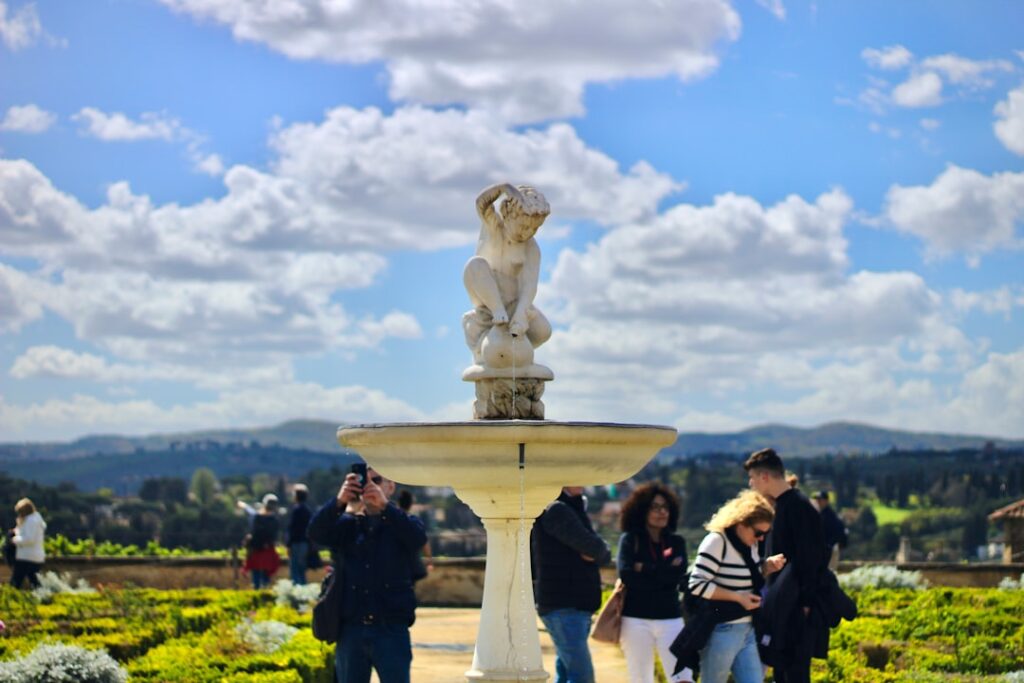
Among the eye-catching pieces are small sculptural groups showing putti (putti = little angels) interacting with a guardian angel or an allegorical figure. Typical of Italian gardens from the 17th–19th centuries, these works add an intimate, almost narrative touch to the walk: a putto splashes water, an angel watches over, a figure smiles.

The charm of these sculptures comes from their human scale—you can almost imagine them alive. Putti are often tucked into niches or placed beside water jets, creating little scenes meant to delight passersby. The rendering of faces, the softness of the bodies and the way the stone catches light give these groups an immediate emotional appeal.
Practical tips: these sculptures are popular with families and children—if you travel with youngsters, have them hunt for hidden putti among the garden’s corners. For detail-loving photographers, move in with a short focal length to isolate features, and try low-angle shots to dramatize expressions.
5) Antique fragments and repurposed sarcophagi
Giardino Bardini also contains ancient remnants and repurposed fragments: architectural pieces, sarcophagus elements and reliefs integrated into walls or displayed as decorative features. This reuse (spolia) is common in Florentine gardens: these ancient objects get a second life, their patina linking them to a broader historical narrative.

These fragments tell a different story: they’re not showcased as centerpieces but serve as ornamentation and archaeological clues. Look for Latin inscriptions, floral motifs in low relief and carved borders. They provide an intriguing contrast with newer sculptures and let you read the garden’s chronological layers.
Practical tips: use a camera zoom or a macro lens to inspect inscriptions and relief detail. These elements are fragile—obey signage and do not touch ancient surfaces. History buffs should note exact locations of fragments so they can cross-reference them with museum records later.
6) The saint or saintess statue in the chapel niche
In one tucked-away fold of the garden, near a small oratory or secondary chapel, you’ll often find a religious statue—a saint or saintess—placed in a shaded niche. These statues, sometimes carved in white marble or stone, reflect the private devotional practices and heritage of the garden’s successive owners.
Protected from direct sunlight, the statue often shows greenish tones from moss and humidity, giving it an almost mystical halo. Facial expression, hand gestures and attributes (a palm, a book, a cross) can help identify the figure. If there’s an explanatory plaque, read it to learn the work’s provenance: a patron’s donation? a recent restoration? transferred from another estate?
Practical tips: this spot is perfect for a moment of quiet reflection. If you enjoy low-light photography, a discreet tripod (if allowed) will yield powerful images. Check signage to see if the statue belongs to a protected collection—flash photography may be prohibited in that case.
7) Monumental vases and decorative trophies at the terrace tops
Finally, a common sculptural typology at Bardini is the monumental vase and decorative trophy. Placed at balustrade ends, atop columns or on terrace corners, these carved stone vases help structure the garden’s geometry. Their motifs (garlands, masks, acanthus leaves) reflect a refined decorative tradition.
These vases in hard stone act as visual anchors and punctuation marks along sightlines. Photograph them in silhouette against the city for dramatic results, or get close to show ornament details and stone texture. They’re periodically restored but retain a patina that tells the story of the seasons.
Practical tips: vases are often behind low barriers—don’t attempt to climb them. For compositions, use a shallow depth of field to isolate ornamental motifs, or a wide-angle to emphasize their monumental presence within the urban panorama.
General practical information for your visit
- Address: Giardino Bardini, Costa San Giorgio 2, 50125 Firenze FI, Italy.
- Indicative opening hours: April–September ≈ 08:15–19:30; October–March ≈ 08:15–16:30. Closures or reduced hours possible. Check the official site before your visit.
- Indicative prices: single adult entry ≈ €10; reduced ≈ €7; combined Giardino Bardini + Giardino di Boboli ticket ≈ €12–15. Student/young/senior rates may vary.
- How to get there: on foot from Ponte Vecchio (10–15 minutes) by walking up toward Costa San Giorgio; or by bus (urban lines serving the Oltrarno area). Taxis can drop you near the main entrance.
- Accessibility: the garden includes stairs and slopes; some areas are not fully wheelchair-accessible. Check info on accessible routes and entrances.
- Best time to visit: spring (rose bloom) and autumn (golden light and mild temperatures). Early mornings and late afternoons offer the best light for sculptures.

Conclusion: A sensitive, curious visit at the heart of Bardini
The Giardino Bardini is more than a garden: it’s an artistic route where sculpture converses with nature, urban life and memory. The seven sculptures or groups we covered—the staircase and its allegories, fountains and river gods, terrace busts, baroque putti, antique fragments, the niche religious statue and monumental vases—offer a representative sample of the site’s formal and historical richness. Each proposes a different way of inhabiting the space: monumentality, intimacy, reinterpretation of the past, devotion or ornamentation.
Practically speaking, remember the shared tips: choose quieter time slots for the best light and calm, respect protective measures around artworks, and wear comfortable shoes for stairs and terraces. To deepen your experience, pair your visit with the Giardino di Boboli or the Museo Bardini (check combined ticket options): you’ll see how outdoor sculpture fits into a museum-landscape continuum that is quintessentially Florentine.
Click here to book a combined David, Pitti and Boboli tour

Finally, remember that practical details (hours, prices) can change: always check official information before you leave. Whatever the timing, Giardino Bardini has a rare ability to surprise: a carved detail in a hidden corner, a rosebed framing a putto, an antique silhouette backlit—plenty of reasons to stroll slowly and let the city reveal itself from a less-traveled angle. Enjoy your visit and happy discoveries in Florence!